
Every winter after the first big storm and the first sunny afternoon that follows it, the calls start: a ridge of ice along the gutter line, icicles the size of fence posts, and a brown stain spreading across the ceiling under the eave. The roof gets the blame. The roof is innocent. An ice dam is the last link in a chain that starts at a ceiling nobody sealed, and the way to stop it is in the attic, not on the shingles.
What an ice dam actually is
University of Minnesota Extension, which has studied ice dams longer than anyone, lays out the conditions plainly: there has to be snow on the roof, and the upper parts of the roof surface have to be above 32 degrees while the lower parts are below it. Snow melts over the warm upper roof, the water runs down to the cold eave, and it freezes there. Every afternoon of melt adds a layer. Eventually water backs up behind the ice, finds its way under the shingles, and shows up inside as that stain.
So the question is never why the eave is cold. The eave is supposed to be cold. The question is why the upper roof is warm, and the answer is almost always the house underneath it. Some heat conducts up through a thin attic floor. But the Extension notes that in many homes, air leakage from the house into the attic is the major way heat reaches the roof. Warm room air rises through open top plates, recessed lights, bath fans that dump into the attic, and an attic hatch with no weatherstripping, and it lands on the underside of the roof deck. That is the melt.
Why sunny Colorado gets them at all
Ice dams get filed under Minnesota and Vermont, and we have our own version. A clear afternoon at 5,000 feet puts intense sun on a snow-covered roof. South-facing slopes melt; north-facing eaves and anything under a tree stay frozen into the evening. Thirty-degree swings between afternoon and night mean melt every day and a hard freeze every night, which is exactly the rhythm that builds a dam. And most of the housing in Fort Collins, Loveland, Longmont, and the Denver metro went up between the 1960s and the 2000s, before anyone sealed a ceiling. Add the two together and you get the house on the block that grows a dam every February while the neighbor with the identical roof does not. The roofs are the same. The ceilings are not.
The fixes that treat the ice
Heat cables melt escape channels so water has a path off the roof. They do not stop the dam forming, they draw power all winter, and the roof is still being heated from below. Chipping the ice damages shingles and people, and the dam is back within days. A roof rake does remove the raw material, and it is worth doing in a bad week to prevent damage. None of them touch the cause. Neither does a new roof: a new roof over a warm attic grows the same dam, and the ice-and-water membrane under the shingles limits the leak rather than preventing the ice.
One more that surprises people: blowing more insulation over a leaky ceiling. It helps a little with conduction and can make things worse, because it traps the warm air leaks under a blanket and keeps the attic damp. Sealing comes first.
The fix that treats the heat
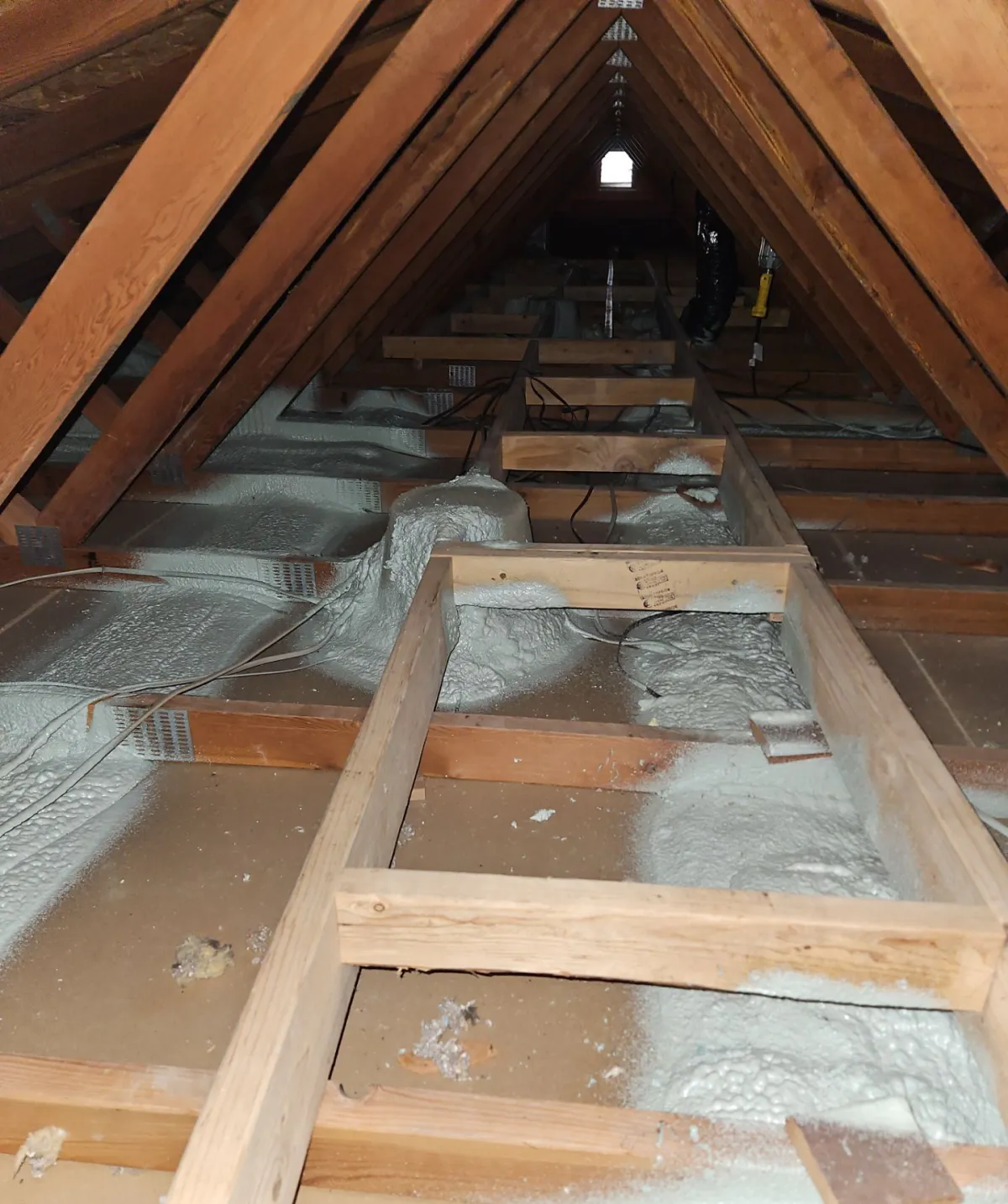
The Extension’s instructions are in a specific order, and they are ours too. First, make the ceiling airtight so warm house air cannot reach the attic. Then add insulation to cut the heat that conducts through. Then keep the attic ventilated so whatever heat still gets up there leaves through the soffits and the ridge. A roof deck that stays at outdoor temperature from ridge to eave cannot grow a dam, because nothing melts.
In practice that is a one- or two-day attic job. A blower door test depressurizes the house and a thermal camera shows every warm plume rising into the attic. On a snowy day the roof is its own map: bare streaks across a white roof sit right above the leaks. Then top plates, can lights, penetrations, and the hatch get sealed, any fan venting into the attic gets rerouted outside, baffles go in at every eave so the vents stay open, and the attic is blown to the R-value ENERGY STAR recommends for our climate zone. The blower door runs again so the result is a number, not a promise.
Why fall is the time
The attic is cool enough to work in, the crew is not fighting snow, and the fix is in place before the first storm instead of after the first stain. It is also the same work that cuts the heating bill and evens out the upstairs bedrooms, so you are not buying an ice dam job; you are buying the attic upgrade the house needed anyway, and the dams stop as a side effect. Efficiency Works and Xcel rebate the air sealing and the insulation, and we file the paperwork. Our ice dam prevention page has the full method and the questions people ask most.